Showing posts with label Marvin Gaye. Show all posts

Monday, April 21, 2008

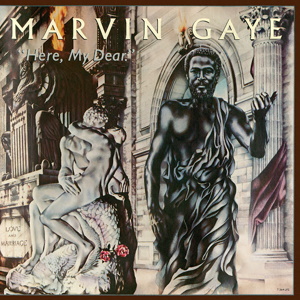
No. 462: Here, My Dear


Band: Marvin Gaye
Album: Here, My Dear
Why Rolling Stone gets it right: Despite being hated at the time, Marvin Gaye's album based on breakups (specifically his divorce) is mean, but great. It's been sampled a million times and rightfully so.
Why Rolling Stone gets it wrong: As double albums go, this is one of the best, but it remains a double album. It has some filler and the topic (Gaye's ex-wife) gets a little old.
Best song: The title track is great and "Anna" is wonderful.
Worst song: "Somebody Needs Love" is boring.
Is it awesome?: Sure.

Marvin Gaye and Anna Gordy -- Berry Gordy's sister -- split in 1976. The divorce was quite acrimonious and resulted in a negotiation for Gaye to give half of the royalties from his next album to Anna. Gaye, in interviews, suggested he had two options. The first was to make what he called "a lazy album." The other -- the path he eventually chose -- was to make an album largely about the divorce.

THe result is as pretty as anything Gaye ever put out, but lyrically as vitriolic as ever. "Here, My Dear" is to be read sarcastically, as someone handing over a piece of themselves. Here, he says. "Take this. The double album is a point in time; it's Gaye at his most exhausted while still energetic. Angry, but still soulful, Gaye's pain makes for a great record.

"Anger" is funky and fun, but the lyrics speak of a different Gaye. Sounding something like a Sly Stone record on quaaludes, the track's famous line (Someday soon I'll hope and pray like Jesus/I'll reach that wiser age/hope I will learn I never profit from things I do in rage) speaks volumes about Gaye's state in 1978.

Gaye's voice is such that he can sing just about anything and sound great. The album opener, the title track, is more narrative in its tone -- speaking of Anna using their adopted son against Gaye -- while still angry. "Anna" is sometimes repetitive, but always compelling, as Gaye sings "What's it, husband, makes you so stubborn?" "Sparrow" is similarly harsh, but sonically more of a soul song, with a gorgeous sax line.

While Anna was topic A on the record, her brother did not escape without harm. Gaye's line about Barry Gordy, "you know you had a brother who thought he was cool/when really I was a dumb little fool," is a solid put-down and works well with the "Is That Enough."

(Say it with me...) As with all double albums, "Here, My Dear" has its share of filler. The lore says that the final two minutes of "Is That Enough" is simply Gaye going off to smoke a joint and have the sax player solo for a bit. "Somebody Needs Love" largely apes the guitar riff from "Let's Get It On." "Time to Get it Together" is full of cool harmonies, but ultimately shallow. "A Funky Space Reincarnation" is a mediocre attempt a Parliament-style bassline.

"Here, My Dear," like many great breakup albums, is often an exercise in overkill. The theme of divorce and bitterness is slightly overdone, but Gaye's voice makes up for it in spades.

Wednesday, September 26, 2007

No. 165: Let's Get It On


Band: Marvin Gaye
Album: Let's Get It On
Why Rolling Stone gets it right: The template for all slow jams and sex records, "Let's Get It On" gets Marvin Gaye at his sensuous best.
Why Rolling Stone gets it wrong: If there ever was a one-note themed album in existence, "Let's Get It On" is it. There's not a lot happening here other than pure, unadulterated sex grooves.
Best song: What can I say about the title track that hasn't already been said?
Worst song: I can't get the Kanye West song out of my mind when I hear "Distant Lover."
Is it awesome?: Sure. Why not?

The irony in "Let's Get It On" is that some of the material was originally written as spiritual songs, including the title track. The story goes that Ed Townsend -- one of Gaye's closest friends -- convinced him to charge the album with more sexuality and rework some unfinished songs ("Come Get To This," "Distant Love" and "Just To Keep You Satisfied") into more sexual music.

And "Let's Get It On" is the result. Like Sam Cooke and Otis Redding basically created soul music, Gaye created the slow jam on this record. The beats specifically emphasize a certain, ahem, rhythm. It's probably not unfamiliar to anyone reading this. This is intentional and would continue.

It's not hard to see the influence. Gaye's moaning performance (remember, this was released in 1973!) on "Distant Lover" has been aped by Prince millions of times. The bawdy lyrical content certainly influenced later artists like Rick James ("Let's Get It On" and "Give It To Me, Baby" are, in essence, the same plea).

And, let's be honest here, R. Kelly just wishes he was Marvin Gaye.

(Lest we forget Gaye's sartorial influence. His prep-school shirts, beard and kufi are a look that influenced some [Kanye West, The Roots] and is actually copied by others [Common]).

"Let's Get It On" gets to the point and doesn't mess around. It's the best of its kind.

Wednesday, June 6, 2007

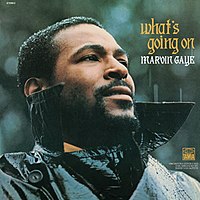
No. 6: What's Going On


Band: Marvin Gaye
Album: What's Going On
Why Rolling Stone gets it right: Well, it's the standard by which almost all soul records are measured. It's one of the most socially conscious records of all time. Marvin Gaye is one of the best singers ever and this is his masterpiece. In an age where soul has been bastardized to mean some foul-mouthed kid singing a ringtone before a rapper chanted about how he's going to take a girl in the ass, Marvin Gay was singing sounds like “Inner City Blues.”
Why Rolling Stone gets it wrong: I don't know that soul is right for this list, but I have to admit that I'm pretty ignorant about soul music.
Best song: Either “Mercy Mercy Me” or the title track.
Worst song: “God is Love” isn't great and “Right On” goes on too long.
Is it awesome?: Absolutely. I wonder about the 500 list (I think it should be just rock and roll records), but probably just my own ignorance.

I am not a Christian, so the records with more Christian overtones are always ones I won't get necessarily and this one is no different. Some of the songs have overtly religious themes – obviously, “God is Love” -- and that's not my bag.

Still, it's hard to disagree with any of these songs in context. Coming out of Motown – where most of the songs were written for Gaye – this record is amazing. He wrote introspective, socially conscious songs about problems affecting black America in the early 70s. That's hugely important, as a lot of artists weren't doing that. Black music didn't have a lot of protest songs and certainly none with the gravitas or import as Marvin Gaye's masterpiece. I mean, hell, this is “The Message” almost ten years before “The Message.”

And you know something? It sounds great. That makes it even better.