Showing posts with label Stevie Wonder. Show all posts

Tuesday, December 18, 2007

No. 284: Music of my Mind


Band: Stevie Wonder
Album: Music of my Mind
Why Rolling Stone gets it right: The first of what are considered Wonder's great five albums, "Music of my Mind" is Wonder's virgin foray into funk. Unlike his squeaky clean Motown-sounding records, "Music of my Mind" utilizes his stable of keyboards and synths.
Why Rolling Stone gets it wrong: I just don't find the record to be exciting. There are a couple of upbeat numbers, but the record is mostly forgettable songs.
Best song: "Love Having You Around" is bizarre, but fun.
Worst song: I don't care for "Evil."
Is it awesome?: The seeds are there, but the plants didn't sprout until later.

Here's something I've been wondering: Are all keyboards the same, in terms of ability to play them? Steve Wonder is, without a doubt, a nearly unmatched musical, so I guess my assumption that he can play any keyboard is fine. But, can a piano player pick up a Moog or an Arp synth and bang something out? How about a harpsichord?

---

There are two things I need to remind myself when thinking about "Music of my Mind. The first is written on the back of the album cover: "this album is virtually the work of one man." Wonder played all the instruments on this album, save for one trombone part and one guitar solo. That, in and of itself, is impressive. I know a few artists on the list did similar things -- "The Downward Spiral" comes to mind -- but, considering Wonder's blindness, it's even more impressive.

The other fact I have to remember is that the record was recorded in 1971. Stevie Wonder was born in 1950. When I was 21, I was watching "Spongebob" on mute while listening to King Crimson records (don't knock it until you've tried it) and eating Cheetohs for breakfast. So, yeah. Impressive.

With all that said, I am not the world's biggest "Music of my Mind" fan. Unlike "Talking Book" or "Innervisions" there is no "Superstition" or "Higher Ground" and there is no string of genius like "Songs in the Key of Life." It's a nice record that works very well as background music.

---

For what it's worth, the album opener is my favorite on the record. The song's synth part is raucuous and Wonder is clearly enjoying himself. Still, the chorus lyrics are, um, strange.

Every day I want to shake your hand, yea, yea, yea,
For in the world makin' me a better man,
And every day I want to get on my camel and ride


Um. A camel? What? Why does he have a camel? Are there a lot of camels in Detroit?

Friday, August 3, 2007

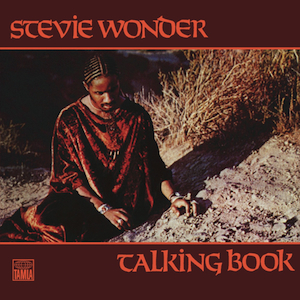
No. 90: Talking Book


Band: Stevie Wonder
Album: Talking Book
Why Rolling Stone gets it right: "Talking Book" is probably Stevie Wonder's funkiest record. "Maybe Your Baby," "Big Brother," "Tuesday Heartbreak" and "Superstition" are probably his funkiest songs. The record also features "I Believe (When I Fall in Love It Will Be Forever)" and "You Are the Sunshine of My Life" are among his best love songs.
Why Rolling Stone gets it wrong: I'm OK with this ranking.
Best song: "Superstition," probably. "You've Got It Bad Girl" is also fantastic.
Worst song: I'm not sure there's really a terrible song. "Blame It On The Sun" starts off slow, but is still a really great song.
Is it awesome?: Absolutely.

Let's talk about keyboards for a minute. In addition to the normal piano, a rock musician in the early '70s had his or her pick of several electrified keyboards. There was the ARP keyboard and the Moog, both the first real electronic sounding keyboards. There's the Fender Rhodes (basically, a honky tonk piano sound). There was, of course, the clavinet.

Stevie Wonder used all of them on "Talking Book." He used them instead of augmenting the record with strings. He used them in double overdubs. He used them for lead melodies. He put them through effects.

And boy, did the record come out well.

"Talking Book" spans the gamut from the bookend love songs -- "I Believe (When I Fall in Love It Will Be Forever)" and "You Are the Sunshine of My Life" -- to the charged political funk of "Big Brother" to the occult-y classic (now played every year on October 31) "Superstition."

Keyboards in rock and roll don't take center stage much and moreover, they don't sound like heavy effected guitar. The keyboards on "Talking Book" do. From the wah wah of "Superstition" to the slight chords on "You Are the Sunshine of My Life," it's hard to tell where the guitars end and the keyboards start. In fact, I still have trouble discerning which is which on "Blame It On The Sun."

The last of Wonder's great trilogy, "Talking Book" is amazing. It was one of the first R&B records that spans genre and really brought rock fans over.

Wednesday, July 11, 2007

No. 56: Songs in the Key of Life


Band: Stevie Wonder
Album: Songs in the Key of Life
Why Rolling Stone gets it right: Stevie Wonder's epic double album spanning the romantic, sweet and socially conscious, "Songs in the Key of Life" is a masterpiece. Everyone from Rolling Stone to Robert Christgau finds it to be great and it's one of (in my opinion) Wonder's three great records.
Why Rolling Stone gets it wrong: Some of the stuff doesn't really work. Still, it's mostly rated well. There is filler on there, but it is a classic.
Best song: "Isn't She Lovely?" is a very pretty little song.
Worst song: "As" is not so good and it goes on too long.
Is it awesome?: Yes.

I've mentioned the "big three" Stevie Wonder albums in my capsule about "Innvervisions" and I'd suggest "Songs In The Key Of Life" is the best of the three. While it's a double album (as in, there's lots of filler), some of Wonder's best songs reside here. The brass bombast of "Sir Duke," the snide irony of "Village Ghetto Land," the history lesson of "Black Man" and the saccharine sweetness of "Isn't She Lovely?" all populate "Songs In The Key Of Life."

There is also enough weirdness to keep one satisfied. "Have A Talk With God" isn't up my alley (again, I worship the sun), "I Wish" is just not my bag (Thanks, Will Smith) and "Saturn" shows that you don't have to see to take psychedelic drugs.

Overall, it's probably Wonder's best work.

Tuesday, June 19, 2007

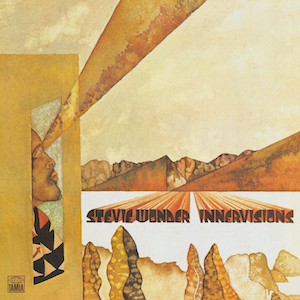
No. 23: Innervisions


Band: Stevie Wonder
Album: Innervisions
Why Rolling Stone gets it right: One of Stevie Wonder's great three albums, "Innervisions" has two of Wonder's more famous songs, "Don't You Worry 'Bout A Thing" and the often-covered "Higher Ground." Moreover, the record is his most socially conscious record and has poignant songs about drugs, politics and urban decay.
Why Rolling Stone gets it wrong: This is something I'll get into as I write about Miles Davis, but any black artist post-1965 needs to write a record filled with protest songs in order for RS to care about it. That really doesn't matter here, as this album is quite good.
Best song: Probably "Higher Ground."
Worst song: Because of my religious beliefs (I worship the sun) "Jesus Children of America" is not up my alley.
Is it awesome?: Sure.

I had a pretty negative view of Stevie Wonder going into high school, as my childhood was littered with commercials soundtracked by the blind singer. "I Just Called to Say I Love You," "Part-Time Lover" and "Happy Birthday" were all commercial radio songs when I was a small child and I think I developed a little disdain for Wonder because of those syrupy nonsense tracks.

Due to a friend who was a big soul fan, I eventually got into the three albums I consider to be Wonder's best work: "Talking Book," "Innvervisions" and "Songs in the Key of Life." These albums, to me, are Wonder at his best: Funky and smart. It's easy to find him to be sentimental nonsense if all you know is the records he did in the '80s, but in the mid-70s, Wonder did a lot of very soulful, driving funky songs. "Living for the City" is a good example of that type of song.

"Innervisions" saw Wonder being overtly political and socially critical. In addition to the anti-drug "Too High," Wonder took on Richard Nixon in the album's closer "He's Misstra Know It All." Like "What's Going On," Wonder sees religion as a solution to the problems of urban decay and underachievement in "Higher Ground" and "Jesus Children of America."

I'm sure a lot of my generation know "Higher Ground" from the cover version the Red Hot Chili Peppers did in 1989. That cover version has been in a million movies and most recently, the video game "Guitar Hero II." It's a testament to the greatness of that song that it remains the only listenable Red Hot Chili Peppers song.

Overall, "Innervisions" is a wonderful album that slots well on the list. Clearly, Wonder's years as a young singles artist are more influential, but "Innervisions" is probably his best album, start to finish.

Postscript: As you can probably notice, I can't write on Stevie Wonder with the zeal that I do the Beatles or Nirvana. This guy, however, writes extensively about Wonder and I recommend his paper.